
-1.png)

Table of Contents
Like this article?
Subscribe to our Linkedin Newsletter to receive more educational content
Subscribe now
Customer-Facing Reliability Powered by Service-Level Objectives
Service Availability Powered by Service-Level Objectives
Learn More
Integrate with your existing monitoring tools to create simple and composite SLOs

Rely on patented algorithms to calculate accurate and trustworthy SLOs

Fast forward historical data to define accurate SLOs and SLIs in minutes
The limitations of traditional MTTR and MTTD
Mean Time To Recovery (MTTR) and Mean Time To Detect (MTTD) have dominated incident metrics for decades, providing simple numerical answers to complex reliability questions. These measurements focus on speed. How quickly can teams detect problems and restore service after outages occur?
While useful for certain reporting contexts, they create misleading pictures of actual system reliability.
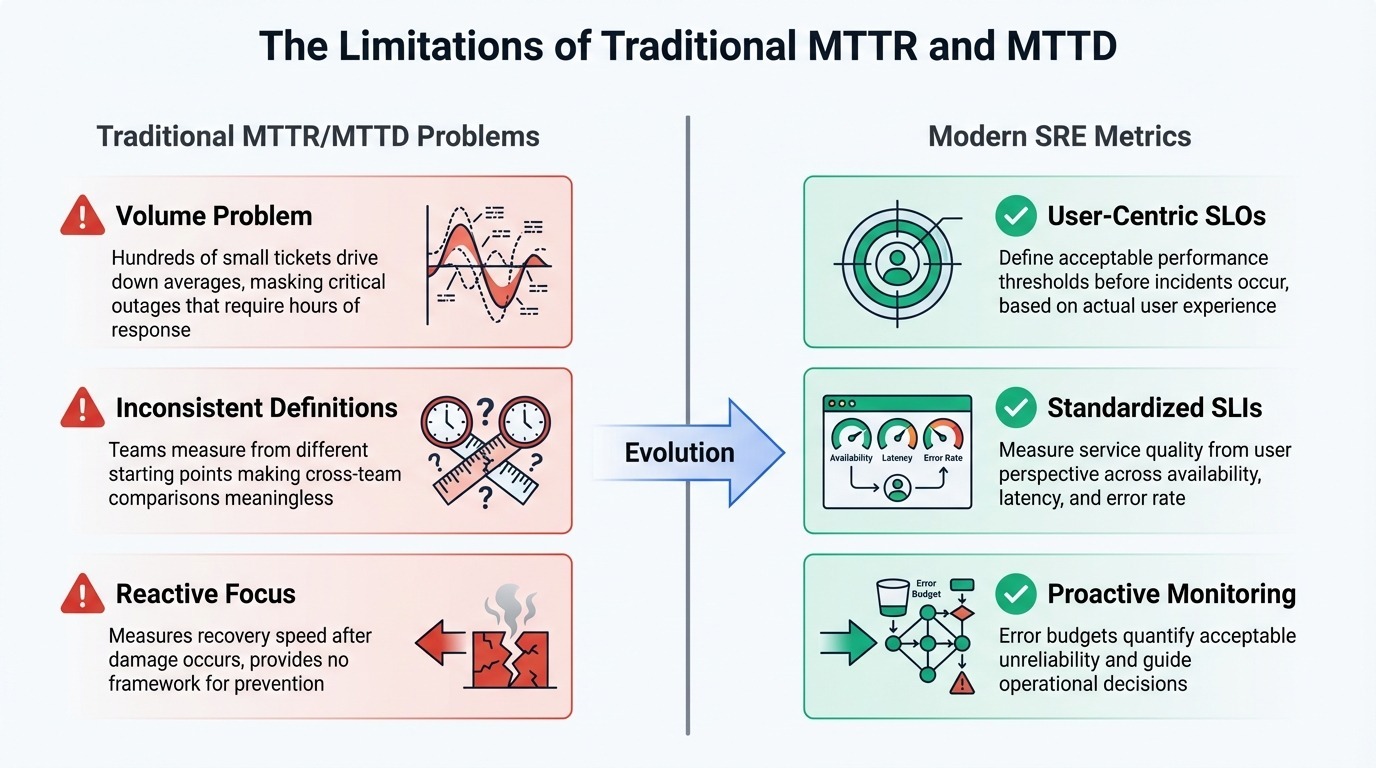
How traditional MTTR and MTTD metrics fall short, and the modern SRE approaches that replace them.
Inconsistent definitions
Inconsistent definitions make comparisons meaningless. Different teams measure MTTR from different starting points:
- Detection time (when monitoring alerts)
- Ticket creation (when someone files an incident)
- User impact (when customers first experience degradation)
One team's 30-minute MTTR might include hours of undetected degradation, while another's 2-hour MTTR starts from the moment alerts are fired. These incompatible definitions render cross-team benchmarking and trend analysis useless.
Misleading aggregations
The volume problem distorts aggregate metrics. Hundreds of small tickets resolved in minutes, drive down average MTTR while masking critical outages that require hours of coordinated response. An SRE team might report an impressive 15-minute MTTR when most incidents resolve quickly through automated restarts, yet spend entire weekends recovering from database corruption that affects thousands of customers. The aggregate number obscures the reliability pattern that matters most.
Misrepresents recovery impact
MTTR measures recovery speed after damage occurs, providing no framework for preventing incidents in distributed systems where small degradations cascade into major outages. A service might maintain excellent MTTR by quickly rolling back failed deployments while suffering constant minor incidents that erode customer trust.
Misrepresents customer impact
Traditional MTTR also fails to measure customer impact. A 10-minute outage affecting authentication during peak shopping hours causes vastly different damage than a 2-hour maintenance window at 3 AM, yet both contribute equally to MTTR calculations. Modern reliability engineering requires metrics that account for actual user experience.
MTTR remains useful for PR and shareholder communication where simple numbers carry weight. SRE teams should maintain these metrics for executive reporting while building operational practices on more sophisticated reliability measurements.
Service level objectives as a proactive reliability framework
Service Level Objectives (SLOs) define acceptable performance thresholds before incidents occur. It establishes clear reliability targets based on user experience rather than infrastructure metrics. Unlike MTTR's reactive focus on recovery speed, SLOs specify what "good enough" means and establish frameworks for maintaining that standard through continuous monitoring.
SLOs transform operational questions from "how fast can we recover?" to "how much unreliability will users tolerate?" A payment processing service might set an SLO requiring 99.9% of API requests to complete within 500ms. This target immediately clarifies priorities. Response times beyond 500ms or availability below 99.9% represent reliability failures requiring investigation.
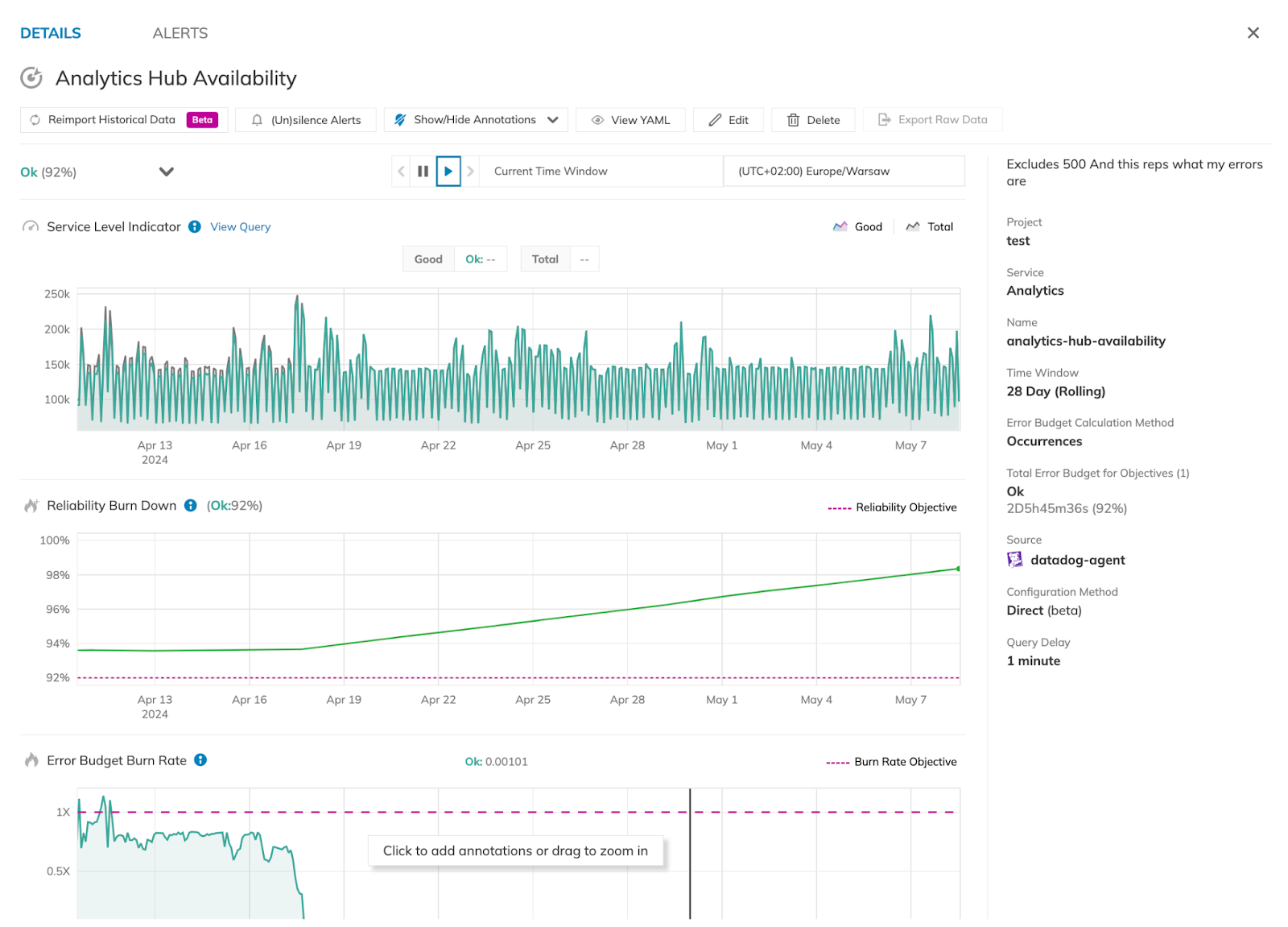
Example of the Nobl9’s SLO dashboard reflecting SLI, reliability burn down, and error budget burn rate
Historical data analysis.
Setting accurate SLOs requires analyzing historical data. Teams examine months of production traffic to understand:
- Typical latency distributions across different request types
- Traffic pattern variations (weekday vs. weekend, seasonal spikes)
- Infrastructure capacity limits under load
- Customer behavior during degradation
This analysis prevents arbitrary targets disconnected from reality. An SLO promising 99.99% availability proves worthless if the underlying infrastructure achieves 99.5% even during perfect operations. Conversely, an overly conservative 95% SLO provides no operational guidance when the system consistently performs at 99.9%. Modern SLO implementations support multi-level hierarchies across different data sources, with weighted components that reflect business priorities.
Nobl9's composite SLOs, for example, let teams combine individual service objectives into a single reliability view. Consider an example of a comprehensive e-commerce SLO that might weight
- Payment processing at 0.6 - customers can complete purchases
- Inventory queries at 0.5 - product availability displays accurately
- Frontend rendering at 0.4 - pages load within acceptable timeframes
This weighted aggregation means a spike in payment failures drives the composite score down even when the other components are performing normally. It keeps engineering attention focused on where the business impact is highest.
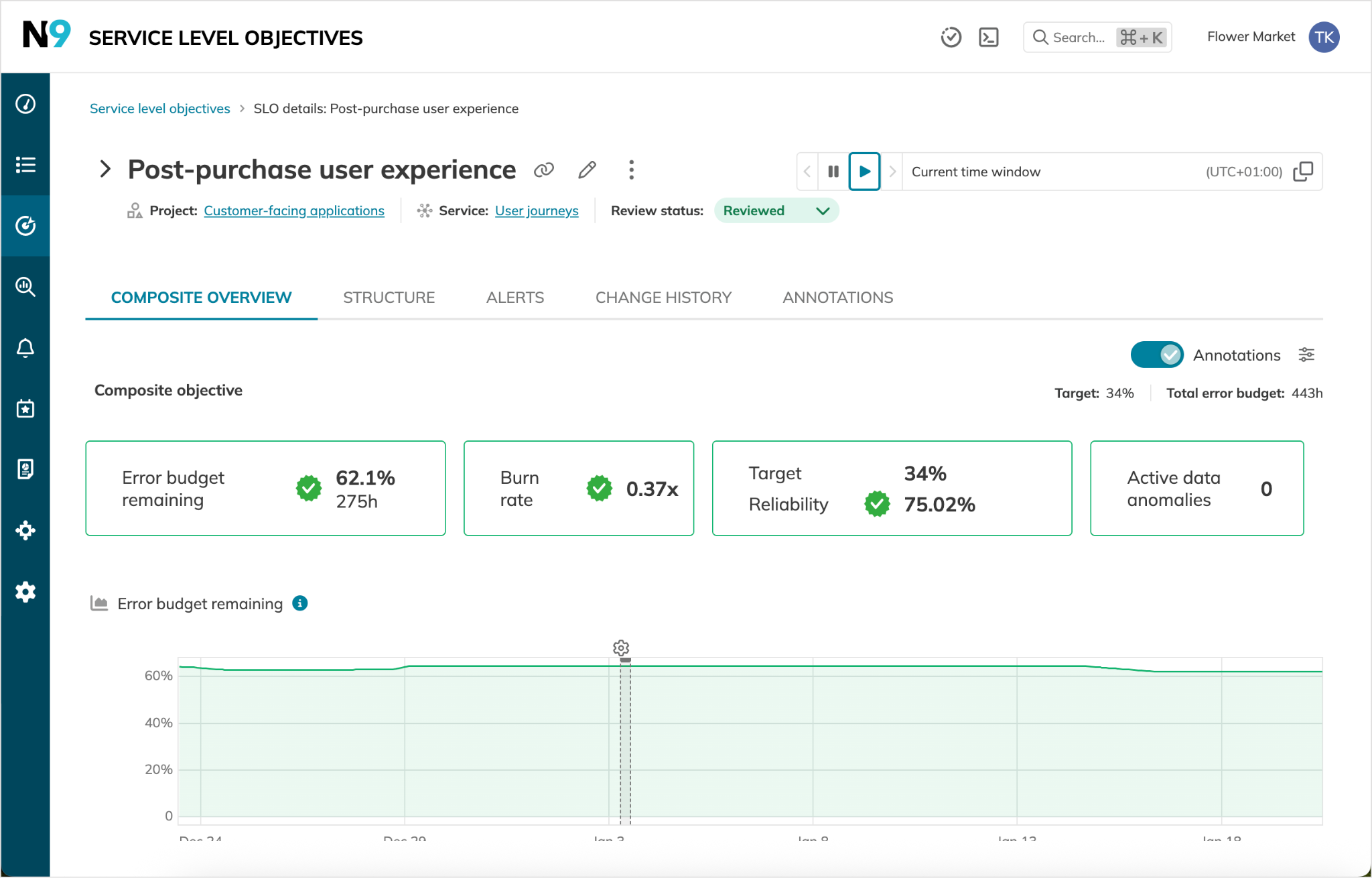
Nobl9's composite SLO view for a post-purchase user experience, showing error budget remaining (62.1%), burn rate (0.37x), and actual reliability (75.02%) against a 34% target across the current time window.
SLOs provide operational frameworks by continuously comparing current performance against defined thresholds. The screenshot above illustrates this in practice: with 62.1% of the error budget remaining and a burn rate of 0.37x, the service is well within acceptable bounds, giving the team confidence to proceed with planned changes. Teams track whether services meet their reliability targets over measurement windows (typically 28 or 30 days), using error budgets to quantify the gap between perfect reliability and acceptable performance. This creates clear decision points, when budget consumption accelerates, teams know to pause risky changes and focus on stability.
Customer-Facing Reliability Powered by Service-Level Objectives
Service Availability Powered by Service-Level Objectives
Learn More
Service level indicators selection and measurement
Service Level Indicators (SLIs) are the quantifiable measurements that determine whether services meet their SLO targets. While SLOs define reliability goals, SLIs provide the actual data showing whether systems achieve those goals from the user perspective.
Focus on customer-visible behavior
SLIs measure what users actually encounter, not what happens inside the infrastructure.
Common SLI categories include:
- Availability: Can users access the service successfully?
- Latency: Do requests complete within acceptable timeframes?
- Throughput: Does the system handle expected transaction volumes?
- Error rate: What percentage of requests fail or return errors?
These differ fundamentally from infrastructure metrics like CPU utilization or memory consumption. High CPU usage might correlate with latency problems, but customers don't experience "CPU" directly. They experience slow page loads or failed transactions.
Effective SLI measurement captures user-facing events within appropriate time windows while carefully handling data-collection delays and missing data.
Use historical SLI patterns for preemptive action.
Teams analyzing months of latency data often find that gradual increases in 95th-percentile response times precede major outages by several hours. When database query performance slowly degrades from 50ms to 150ms over a day, the pattern indicates capacity constraints or query optimization issues. SRE teams can scale infrastructure or optimize queries before median latencies cross SLO thresholds and trigger customer-visible impact.
However, preemptive action is effective only when SLI data is fresh. An SLI reporting 99.99% availability means nothing if the underlying metrics haven't updated in three hours. Advanced implementations track data collection delays and flag stale measurements, preventing teams from making operational decisions based on outdated information.
Example
A web service might measure availability by tracking the percentage of HTTP requests that return successful status codes (2xx) across 5-minute windows. The measurement system must account for monitoring agent delays, network partition scenarios in which metrics can't reach collection systems, and the distinction between "no data" and "service unavailable."
SLI Calculation Example:
successful_requests = count(http_status in [200-299])
total_requests = count(all_http_requests)
availability_sli = (successful_requests / total_requests) * 100

Target: 99.9% of requests succeed
Measurement window: 5 minutes
Alert threshold: <99.5% for 2 consecutive windows
Modern SLO platforms aggregate metrics from multiple monitoring tools and normalize data to ensure consistent SLI calculations. An organization might collect HTTP metrics from application performance monitoring (APM) tools, infrastructure data from Prometheus, and database performance from vendor-specific agents.
For example, Nobl9 addresses this directly through its data source integrations, connecting to over 30 monitoring providers, including Datadog, CloudWatch, and Dynatrace, then handling their different data formats and reporting frequencies to calculate unified SLIs that reflect actual user experience.
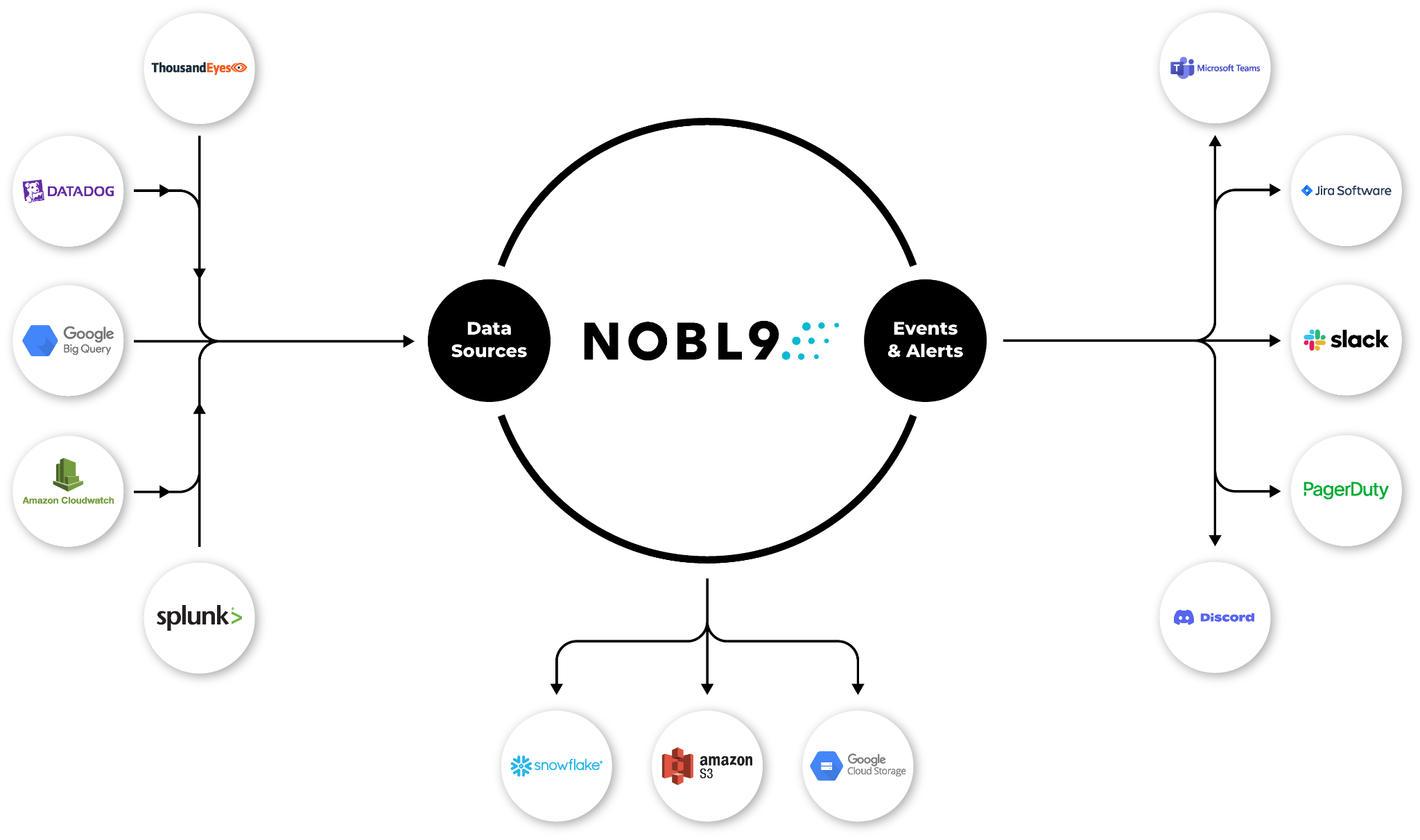
Nobl9 connects to your existing monitoring and observability stack, collecting and normalizing service level indicators (SLIs) from systems using their native query languages.
Error budgets as an operational decision framework
Error budgets translate SLOs into practical operational guidance by quantifying acceptable unreliability. If an SLO targets 99.9% uptime, the corresponding error budget represents the remaining 0.1%, exactly 43.2 minutes of acceptable downtime per month. This creates a finite resource that teams consume through maintenance, deployments, and actual outage.
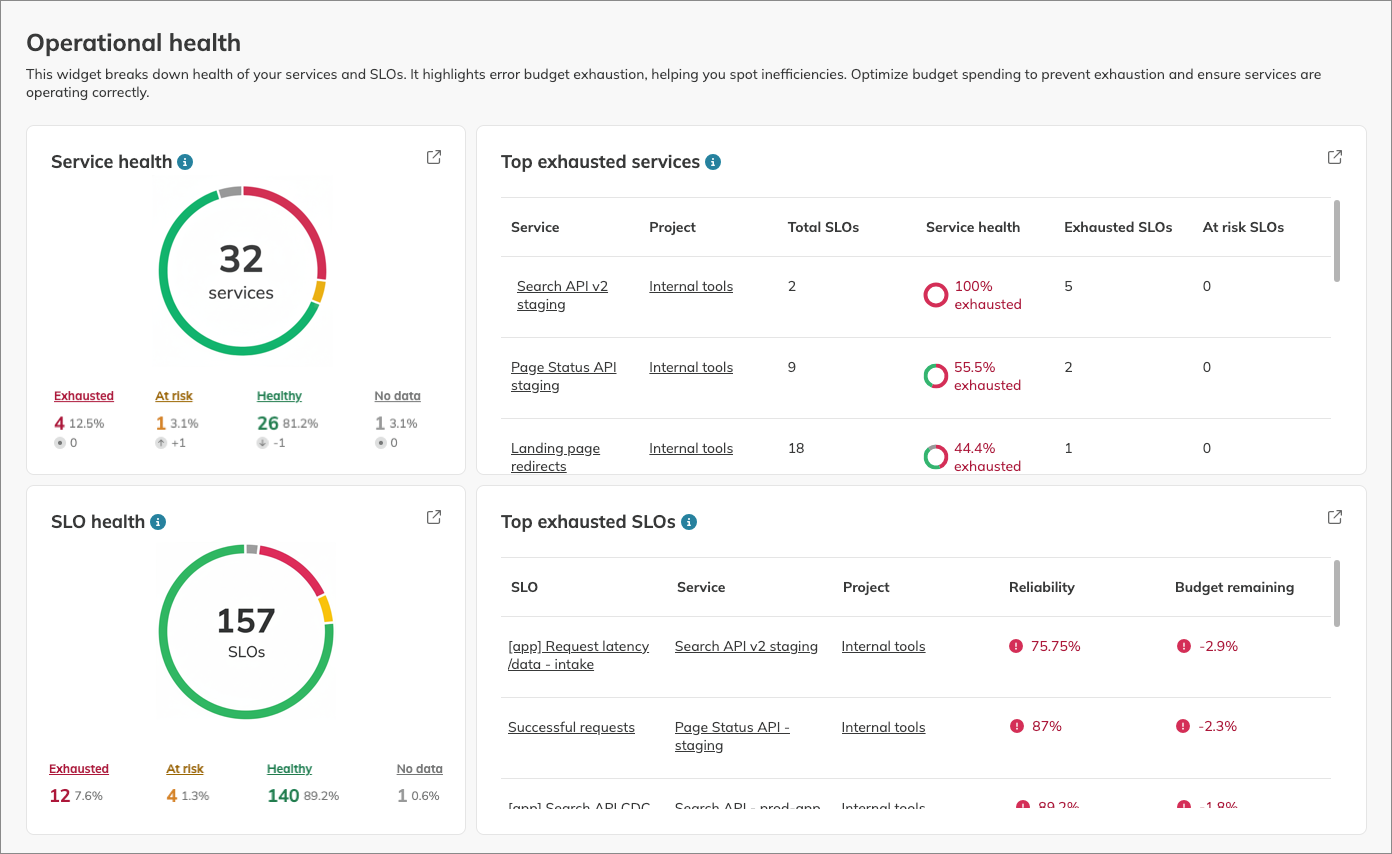
Operational health dashboard showcasing overall service and SLO health.
The budget concept shifts reliability discussions from absolute terms to tradeoffs. SRE teams don't ask "should we achieve perfect uptime?" but rather "how should we spend our unreliability budget?" A team with significant remaining budget might accelerate feature deployments, accepting increased deployment risk in exchange for faster innovation.
Responding to accelerating budget consumption
When budget consumption accelerates, whether through multiple small incidents or a single major outage, the same team pauses risky changes and focuses exclusively on stability work.
Accelerating budget consumption drives specific operational behaviors
- Halting deployments until stability improves
- Scaling infrastructure proactively before reaching capacity limits
- Prioritizing technical debt reduction over feature development
- Scheduling aggressive postmortems to prevent recurrence
These decisions emerge from actual system behavior rather than arbitrary management directives. When error budget policies specify that deployment freezes trigger automatically at 80% budget consumption, teams gain objective frameworks for balancing innovation and stability.
Advanced SLO platforms preserve historical Error Budget data through configuration changes. They enable continuous refinement without losing trend information. Early SLO implementations often reset all historical data when teams adjusted thresholds or measurement windows, forcing teams to start learning patterns from scratch.
Modern systems retain raw event data while recalculating budgets against new configurations. They enable teams to see how different SLO settings would have performed across months of production traffic.
Error Budget Calculation:
Monthly SLO target: 99.9% availability
Total time: 30 days * 24 hours * 60 minutes = 43,200 minutes
Error Budget: 43,200 * 0.001 = 43.2 minutes
Current consumption: 28.5 minutes (65.97%)
Remaining budget: 14.7 minutes (34.03%)
Dynamic budget-based alerting
Traditional monitoring sends alerts when individual metrics cross static thresholds, such as CPU exceeds 80%, error rate above 1%, and response time surpassing 500ms. These alerts lack business context and generate constant noise as systems operate near normal limits.
Dynamic budget-based alerting provides context-aware notifications reflecting actual reliability risk. Notifications are fired based on the budget consumption rate rather than individual metric values.
A brief latency spike consuming 2% of the monthly budget might not warrant waking engineers at 2 AM. But the same spike consuming 15% of the remaining budget triggers an immediate response. The alerting system understands that identical technical events carry different operational significance depending on the current budget status. Multi-window, multi-burn-rate alerting further refines this approach by comparing budget consumption across different time windows.
Nobl9 provides templates for this methodology, detecting:
|
Burn type |
Example |
Indicates |
|
Fast burn |
5% budget consumed in 1 hour |
Acute incidents requiring immediate response |
|
Slow burn |
10% budget consumed over 6 hours |
Degradation, warranting investigation |
|
Threshold violations |
50% budget consumed in any 30-day period |
Postmortem requirements |
Below is an example of the multi-window multi-burn alert policy:
- apiVersion: n9/v1alpha
 kind: AlertPolicy
 metadata:
   name: fast-burn
   project: default
 spec:
   alertMethods: []
   conditions:
   - alertingWindow: 15m
     measurement: averageBurnRate
     op: gte
     value: 5
   - alertingWindow: 6h
     measurement: averageBurnRate
     op: gte
     value: 2
   coolDown: 5m
   description: "Multiwindow, multi-burn policy that triggers when your service requires attention and prevents from alerting when you're currently recovering budget"
   severity: Medium
This multi-tier approach distinguishes transient issues from systemic problems while reducing alert fatigue that plagues teams using simple threshold-based monitoring.
Composite SLOs for complex distributed systems
Traditional single-service SLOs measure individual component reliability but fail to capture how distributed systems actually deliver value to users. A customer completing a purchase interacts with dozens of microservices, such as authentication, payment processing, inventory management, order fulfillment, and email confirmation. Overall user experience depends on all these components functioning within acceptable parameters simultaneously.
Early composite SLO implementations imposed restrictive limitations:
- All component SLOs within single project boundaries
- All metrics sourced from identical monitoring systems
- Equal weighting across components regardless of business impact
These constraints prevented the reliable measurement of architectures spanning multiple teams, cloud providers, and monitoring tools. An e-commerce platform couldn't create meaningful composite SLOs when payment processing ran on a single cloud provider monitored by Datadog, while inventory systems ran on-premises with Prometheus metrics.
Modern multi-level SLO hierarchies combine components across data sources, with weights reflecting actual business priorities.
Example
The payment processing example from earlier demonstrates composite SLOs
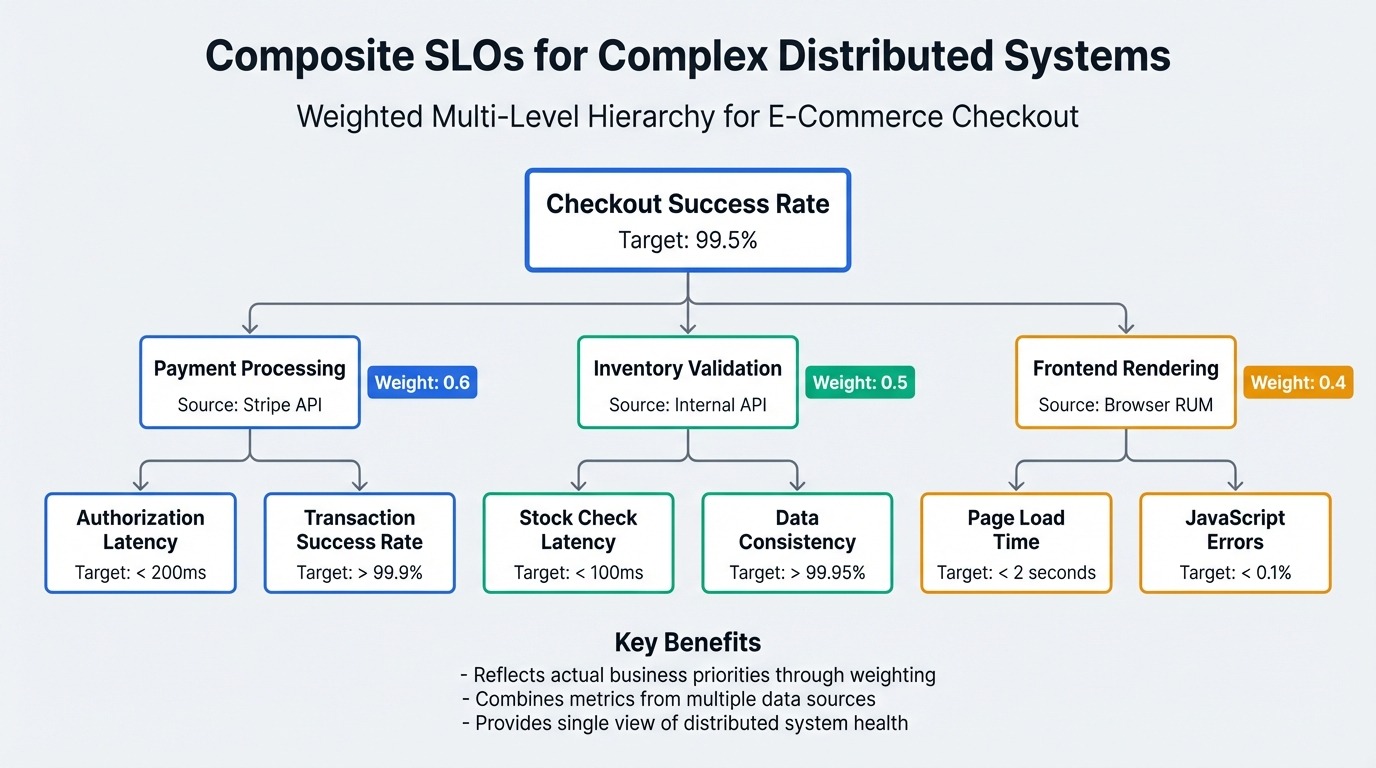
A weighted composite SLO hierarchy for an e-commerce checkout flow, combining payment processing (0.6), inventory validation (0.5), and frontend rendering (0.4) into a single 99.5% reliability target
The weighted calculation accounts for different component criticisms. Payment failures completely block purchases (high weight), while slightly slower frontend rendering degrades but doesn't prevent transactions (lower weight). The composite SLO reflects actual customer impact rather than treating all components identically.
Configuration flexibility addresses data collection delays and missing data by using different alert policies for degradation versus critical failures. An inventory service might report metrics every 60 seconds, while frontend real user monitoring (RUM) aggregates every 5 minutes. The composite SLO system accommodates these different reporting frequencies without generating false alerts during normal metric collection delays.
Benefits
Historical replay allows testing SLO configurations with months of data in minutes. SRE teams refining SLO definitions can replay weeks of production traffic against proposed configurations, immediately seeing how different thresholds and weights would have performed. This eliminates the weeks of trial-and-error previously required to tune SLOs, where teams proposed targets, waited for data, discovered misconfigurations, adjusted settings, and repeated the cycle.
A team considering whether 99.9% or 99.95% availability better matches user expectations can instantly replay three months of traffic against both configurations. The analysis shows:
- Which targets the service actually achieved
- How error budget consumption patterns would have differed
- Whether alerts would have triggered appropriately
- Where budget burns indicated real problems versus acceptable regular operation.
Challenges
Composite SLOs require sophisticated orchestration across multiple teams and systems. Organizations building these capabilities in-house often underestimate the engineering complexity, discovering months into development that maintaining accuracy across distributed metric sources requires dedicated infrastructure teams. The platform aggregating these metrics must handle:
- Authentication and authorization for each data source
- Normalization of incompatible metric formats
- Managing different retention policies
- Weighted result calculations that account for temporary data unavailability.
SLO quality: measuring measurement effectiveness
Implementing SLOs solves reliability measurement problems, but those solutions degrade over time as systems evolve and teams adjust processes. SLO Quality metrics measure how well-tuned individual SLOs remain by tracking configuration health alongside traditional reliability data.
SLO quality evaluates several operational characteristics:
- Review frequency: How often do teams examine and update SLO definitions?
- Budget consumption patterns: Does the SLO consistently burn the budget, or does it remain perpetually at 100%?
- SLI data freshness: Are the underlying metrics reporting current data, or are they showing staleness?
- Alert effectiveness: Do notifications correspond to actual reliability problems?
An SLO with perfect 100% achievement over six months signals misconfiguration rather than excellent reliability. Either the target proved too conservative for the system's actual capabilities, or the measurement stopped capturing meaningful events. SLO Quality metrics flag these situations, prompting teams to investigate whether the monitoring disappeared, the SLO target requires adjustment, or the system actually achieved unexpected reliability improvements.
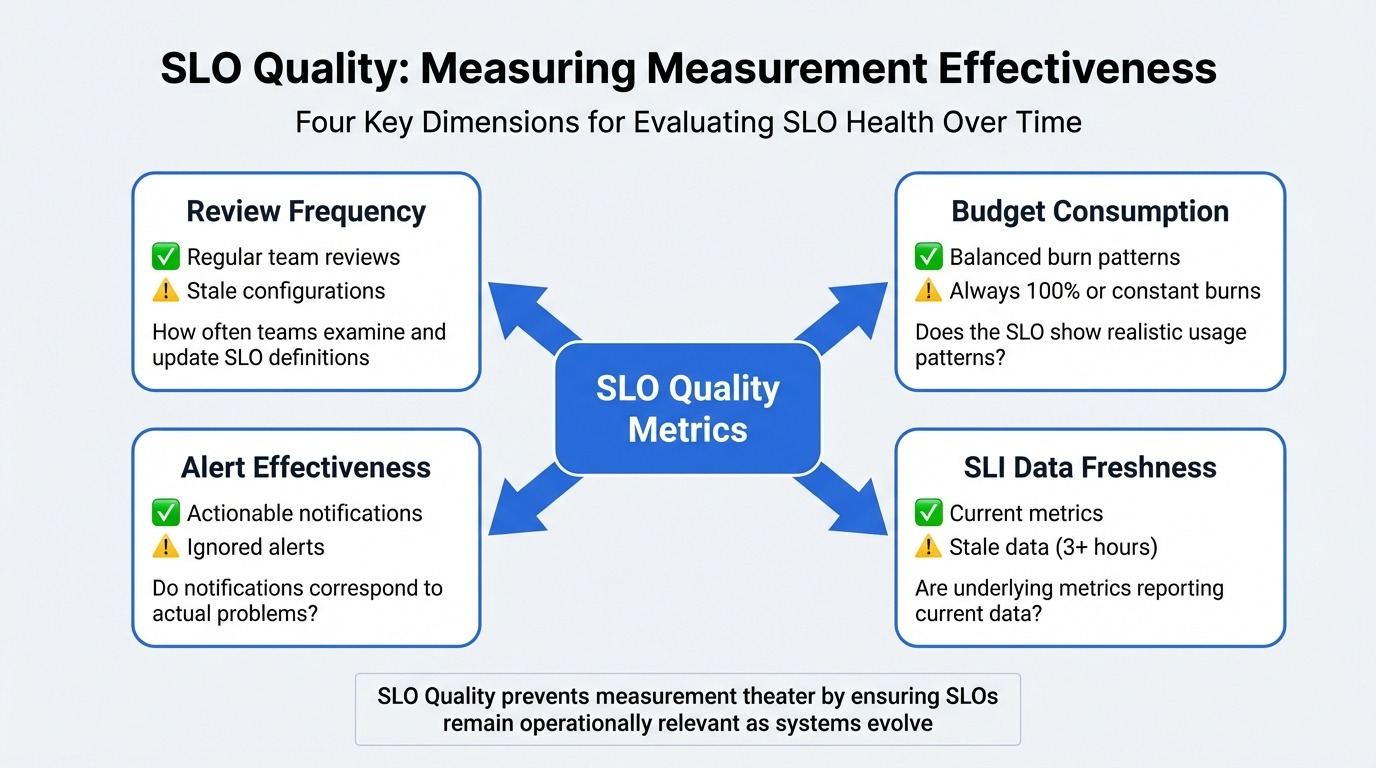
Four dimensions for evaluating SLO health over time: review frequency, budget consumption patterns, alert effectiveness, and SLI data freshness
Conversely, SLOs burning budget constantly while teams never respond indicate definitions disconnected from operational priorities. The measurements might be accurate, but if nobody acts on budget consumption, the SLO provides no value beyond reporting theater. Quality metrics that identify this pattern push teams to either adjust SLO targets to reflect actual operational thresholds or acknowledge that the service lacks appropriate reliability requirements.
SLI data freshness
Directly impacts SLO reliability. An availability SLO calculated from metrics delayed by 3 hours creates false confidence when systems fail. SLO quality tracking flags when underlying SLIs haven't updated within expected intervals, preventing operational decisions based on stale data. Teams can configure different staleness tolerances for different SLI types; latency percentiles might tolerate 5-minute delays while availability measurements require sub-minute freshness.
Configuration drift
Configuration drift presents another quality challenge. Teams create well-tuned SLOs that match system behaviour during implementation, but months later, the infrastructure has evolved, traffic patterns have changed, and the original assumptions no longer hold. Quality metrics comparing current SLO performance against historical baselines highlight when drift occurs, triggering reviews before configurations become meaningless.
The meta-measurement approach enables continuous improvement. SRE teams track SLO quality metrics with the same rigour they apply to error budgets. They treat quality degradation as operational problems requiring investigation and remediation.
Navigate Chapters: